
Life safety and business continuity protection are the number one concern for the developer or property manager in the realm of electromechanical contracting and building engineering. Without a proper network of water-based suppression, a commercial high-rise, a large manufacturing facility or a school will not be able to operate effectively.
Having a dependable fire sprinkler system is one of the most important investments in safety and code that you can make for your structural integrity. This guide discusses how these essential automatic sprinkler system solutions work, what they must include and what regulations will govern them.
What Is a Fire Sprinkler System?
A fire sprinkler system is a water-based fire suppression system that automatically detects, controls and suppresses fire at an early stage. It doesn’t turn on every building simultaneously, as is sometimes believed. Rather, every head in the system is a separate thermal detector that only reacts to heat from a localized fire.
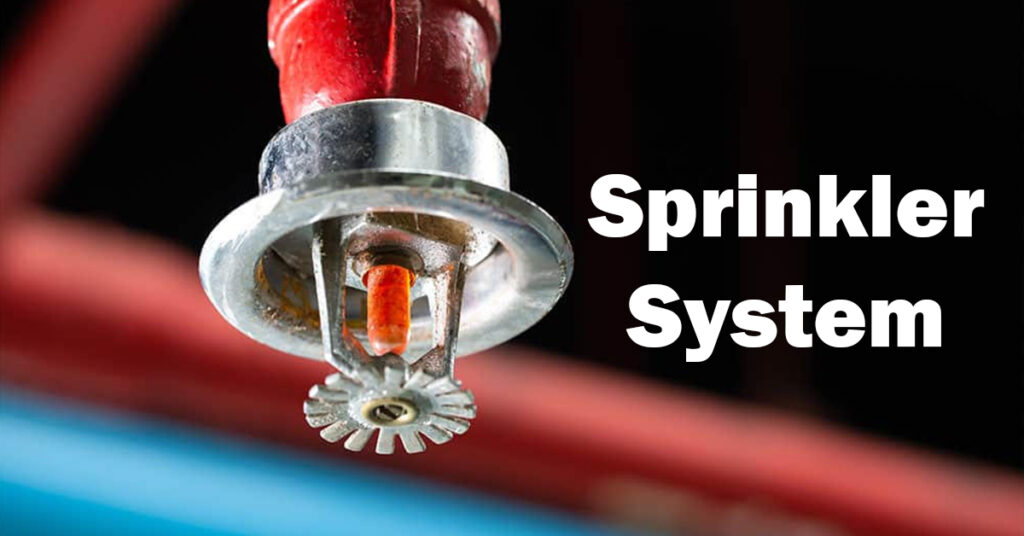
It works mechanically using heat resulting in reliability even in a power off state. When the temperature is reached at which the glass bulb or fusible link is operable, the pressurized water hits the deflector plate, creating an accurate spray pattern to help extinguish the blaze and minimize smoke while maintaining access pathways.
Read More: Fire Fighting System
Components of a Sprinkler System
The following is a breakdown of the various component elements that work together to form a professionally engineered firefighting system:
- Water Source: Any well developed water source with a large amount of water provided, such as drinking water mains from the city, elevated gravity tanks, or concrete underground reservoirs.
- Fire Pumps: High performance centrifugal pumps including BS EN 733 end suction pumps are installed to provide the required flow and head through the piping grid.
- Control Valves: These may include swing check valves and Outside Screw and Yoke (OS&Y) valves to regulate, isolate and stop backflow in the network and are required to be electronically supervised to ensure that those valves are not accidentally closed.
- Main Riser and Piping: The main riser is the vertical pipe that interfaces with horizontal feed mains, cross mains and branch line piping from the main pump room.
- Sprinkler Heads: The last sprinkler heads are evenly spaced on the ceiling or wall and set to come on when a certain temperature is reached.
Types of Fire Sprinkler Systems
Fire sprinkler systems come in various types depending on how water is stored and activated in the piping.
Wet Pipe Systems
Most basic and reliable type of fire sprinkler system. Pressurized water is forced into pipes all of the time: If the sprinkler head turns on, water will go into the grass. Perfect for use in retail spaces and offices.
Dry Pipe Systems
These are used in unheated spaces and areas where freezing is a possibility. Pipes do not fill with water but with pressurized air or nitrogen. Air escapes first then water flows in with the activation of the sprinkler. Ideal for loading docks, refrigerated warehouses and parking garages.
Pre-Action Systems
Systems used in potentially sensitive areas in order to prevent inadvertent damage to water. Until the activation of the separate fire detection system, pipes will allow no water to flow out until individual sprinkler heads open and the pipes will fill before the water begins to flow. This is a common sight in server rooms, data centers, libraries and museums.
Deluge Systems
Suitable for high hazard areas where fire can spread quickly. All sprinkler heads are open and water is released across the entire area when a detection system triggers the main valve. Usually utilized in aircraft hangars and chemical plants.
Read More: Check Valve Types: Complete Guide for Piping and Fire Protection Systems
Wet Pipe vs Dry Pipe Sprinkler Systems
Wet pipe systems are used in heated buildings more than any other fire sprinkler system and maintain pipes with pressurized water, ready to react immediately. Dry pipe systems are suitable for unheated outdoor spaces susceptible to freezing, where the water in the pipes is trapped behind a valve and pressurized air or nitrogen is present to keep the water from freezing, which means there is a slight delay in the water delivery when the sprinkler water is sent out.
| Feature | Wet Pipe Systems | Dry Pipe Systems |
|---|---|---|
| Pipe Contents | Pressurized water | Pressurized air or nitrogen |
| Response Time | Nearly instantaneous | Short delay (air must be released to open the valve) |
| Best Environment | Heated indoor spaces (offices, schools, homes) where temperatures are stable | Unheated or outdoor spaces (attics, parking garages, cold storage) where pipes risk freezing |
| Installation & Maintenance | Simple, cost-effective, and easier to maintain | Complex and requires additional equipment like air compressors and accelerators |
| Corrosion Risk | Moderate | High (Oxygen and moisture interface) |
Types of Sprinkler Heads
Pendent Sprinkler Heads
A pendant head is designed to hang from the ceiling piping down to irrigate in a wide circular pattern and is most common in commercial offices, schools, and suspended ceiling spaces to direct the water over the hazard below.
Upright Sprinkler Heads
Upright heads are typically used in locations where the ceiling is not finished such as an industrial warehouse where water is directed upward against a deflector to pass over or under structures.
Sidewall Sprinkler Heads
They are horizontally installed on a vertical wall and have a specially engineered crescent discharge pattern that works best in hotel rooms, corridors or other narrow areas where overhead ceiling piping is not feasible.
Concealed Sprinkler Heads
Luxury pendant heads are used in high-end corporate head offices, retail outlets and bank branches. The safety system is completely invisible and is recessed into the ceiling with an ornamental protective plate that is removed at pre-activation temperatures, so the safety system is never visible.
Read More: The Difference Between Wet Barrel and Dry Barrel Hydrants Explained
Fire Sprinkler Design Requirements
The principles of fire sprinkler design are based on the NFPA 13 code which determines pipe sizing, spacing, and water supply according to the level of risk within a building.
- Hazard Classification: Occupancies are categorized from light (offices) to extra hazard (chemical plants) to determine water flow needs.
- Maximum Spacing: Standard spray sprinkler heads are placed a maximum of 15 feet apart.
- Wall Distance: Any sprinklers will be within 7.5 feet (or within half the largest distance you can find) of any wall.
- Minimum Distance: Heads must be at least 6 feet apart to prevent water from cooling adjacent heads.
- Hydraulic Density: Systems must supply a desired flow rate per square foot (e.g., 0.1 gpm/sq ft) over the defined design area.
- For remote testing: Calculations need to demonstrate that the farthest, highest sprinkler is pressurized properly.
- System Types: Systems are divided into Wet (always filled), Dry (pressurized air for freezing areas), and Pre-Action (dual-trigger for server rooms).
- Monitoring: All control valves should be electronically monitored by a 24-hour fire alarm system.
NFPA Standards for Sprinkler Systems
It is important to follow international standards when designing and installing an automatic sprinkler system for both legal compliance and the dependable performance of the system.
- NFPA 13: The leading codebook for sprinkler design and installation in commercial and industrial facilities.
- NFPA 13R: The simplified version of NFPA 13, applicable to buildings no more than four stories tall in height.
- NFPA 13D: An easier installation standard just for life safety and escape time for single family homes.
- NFPA 25: the ultimate source of water based fire protection system knowledge and best practices in inspection, testing and maintenance.
Read More : NRS Valves
Inspection, Testing, and Maintenance
Inspection, Testing and Maintenance (ITM) is a crucial activity to ensure fire protection equipment functions correctly in the event of an emergency and a building remains safe.
- Monthly Visual Inspections: Facility staff is responsible for visual inspection of all the control valves, pressure gauges, and fire department connections to confirm their effectiveness and correct position.
- Annual Waterflow Tests: The operation of waterflow alarm devices and maintenance of main drains should be tested by certified technical personnel and designed to simulate an actual activation event in the waterflow alarm device.
- Five Year Component Testing: Pressure gauges should be tested/replaced every 5 years to assure accuracy, and check valves must be inspected internally periodically to ensure all components are free to move.
Common Sprinkler System Failures
An active fire sprinkler system can be extremely effective, but if properly designed or neglected, it can have serious consequences in the event of an emergency. Based on past experience, about 50% of sprinkler fire failures are caused when the sprinkler heads are not in contact with the fire, and 31% are caused by inadequate water supplies to the sprinkler heads.
A closed main control valve, insufficient fire pump pressure, poor fire pump maintenance, internal pipe corrosion, freezing, and significant changes in occupancy not accompanied by an upgraded fire sprinkler system are the most common causes.
Installing a dependable fire sprinkler system to protect your facility is one of the best ways to protect lives, assets and business continuity. The expertise required begins with proper design, then ensuring routine maintenance is conducted in accordance with NFPA standard 25.
Habikon Egypt is committed to providing engineering solutions for addressing challenges from end-to-end. We deliver trusted, world-class fire protection to facility owners through custom sprinkler system designs and supplies that comply with Egypt’s Civil Defense standards and the international NFPA. Call Habikon Egypt today.